

For context: As of today, June 1, 2026, GitHub has fundamentally overhauled the billing model for Copilot. Out with the old Premium Request model (`PRU`), the beloved "*flat rate*", and in with a *token-based* billing system called GitHub `AI Credits`. 1 `AI Credit` costs $0.01. Sounds harmless, right? It isn't.
The experiment: a real conversation and a proper bill
This morning, deliberately as a first small test of my expected future costs, I used Copilot to reconfigure my Llama.cpp server and documented the costs. I've been in the process of switching from OLlama to Llama.cpp for a few days now — more on that elsewhere. Since migrating to Llama.cpp involves a fair amount of configuration work at the script level, and as a UX person I'm not particularly versed in that area, I've been using AI assistance in the form of a CLI for several months. Not as a toy, but as a productive configuration dialog of the kind that's part of everyday life for many developers. The Copilot CLI with Claude Sonnet as its brain has always done pretty solid work here. Until now, the costs were easy enough to stomach given the time saved. Until now.
Key stats for the conversation:
- Duration: approx. 45 minutes
- Topic: Llama.cpp router setup, aliases, LaunchAgent, vision model integration
- Exchanges: approx. 35–40 turns, many with code output, file edits, and shell commands
- Platform: GitHub Copilot CLI / Chat
The result according to the GitHub Billing dashboard: $2.42 gross consumption. In a single conversation, in the first hour of the new month. (The counter was at $0.00 this morning, which made it particularly easy to verify.)
The raw data — delivered by GitHub itself
GitHub provides a CSV export under Settings → Billing → Usage. Here it is, unmodified:
| Date | Product | SKU | Quantity | Unit | Price/unit | Gross |
|---|---|---|---|---|---|---|
| 2026-06-01 | copilot | copilot_ai_credit | 99.60 | ai-credits | $0.01 | ~$1.00 |
The CSV shows a single aggregated row. The dashboard shows $2.42. Why the numbers diverge, I can't say conclusively — the full picture is provided by the screenshot.
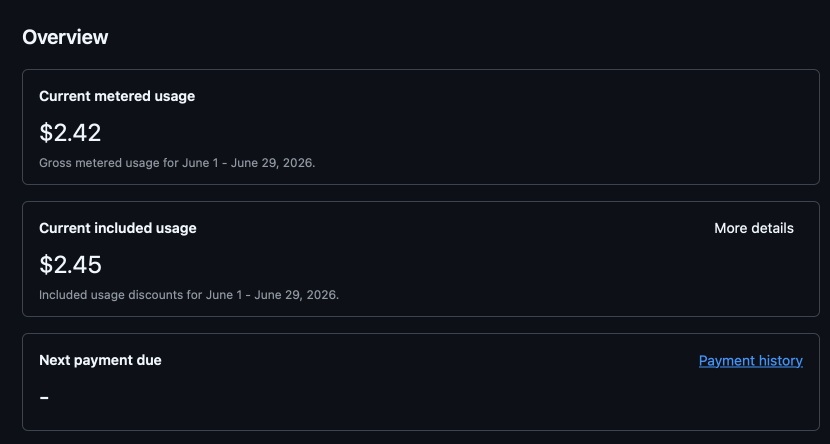
What this means compared to the old model
Following GitHub's switch to the new billing model, all costs that previously disappeared into the flat rate are now made visible and charged directly. My first conversation this morning already cost $2.42. The counter runs from now on with every turn.
The reason lies in the nature of the token-based model: as soon as you open Copilot Chat — whether in the CLI, the VS Code sidebar, or the browser — Copilot sends not just your current question with each turn, but the entire conversation context accumulated so far as input. And this with a model like Claude Sonnet, which is among the more expensive options. In long, iterative conversations, the context grows with every turn and costs rise disproportionately. Code completions in the editor, on the other hand, remain exempt and are not charged separately. The expensive part is opening a chat — and especially Agent Mode.
With full Copilot usage, the way I had gotten used to it, my monthly allowance will likely be exhausted on the first day of the month. Which makes me wonder whether I might as well switch to a different provider entirely.
When does the allowance run out?
Copilot Pro ($10/month) now includes 1,000 AI Credits. Sounds like a lot. It isn't:
- Light user (occasional short questions, ~30 credits/day): budget lasts the whole month — theoretically enough for just over 33 days. Though at that level of usage, I wonder what you'd need a Copilot subscription for. Committing?
- Medium user (1–2 longer sessions per day like today, ~100 credits/day): budget exhausted after 10 days, after which usage costs an additional $0.01 per credit. At another 100 credits per day for the remaining 20 days of the month, that's another $20 on top (~€18). And honestly, my chat today lasted under an hour and cost roughly $2.50.
- Heavy user (intensive coding sessions, 250+ credits/day): budget gone by day 4. After that the counter keeps running for the remaining 26 days, adding at least $65 extra (~€60) at the same pace. A $10 subscription can quickly become a $75+ month.
And if you want to keep that credit consumption in check, my experience says you should under no circumstances use Agent Mode, Code Review, or the new Claude Opus 4. Credits burn even faster there, since every agentic session produces additional internal model calls. The feature is accessible in all paid subscription plans. Whether it stays affordable for every user is a different question.
Dear community: this is going to cost you
This is a real problem. Many developers use Copilot daily and intensively, just like I do, and hopefully have the migration on their radar. Anyone on monthly billing was automatically migrated today. Anyone still on an active annual plan stays on the old model until it expires. Lucky you.
By the way: new plans could no longer be taken out from April 16, 2026 onward. GitHub froze sign-ups for Pro, Pro+, and Student on that date without warning. Anyone without an active plan at that point was locked out.
590 comments and 1,243 thumbs-down on the official announcement speak for themselves: Announcement & FAQ: Changes to GitHub Copilot Individual Plans · Discussion #192963
The consequences for my day-to-day work
From this development, I'm drawing the following immediate plan:
- When do I still use Copilot, and with which model? Claude Sonnet is expensive but good; GPT-5 mini is cheap but mediocre
- Agent Mode is probably no longer an option for me — multiple credit consumption through tool calls
- Set a budget limit? GitHub allows this under Settings → Billing → Budgets, but at my current usage level I'd probably hit the limit quickly
I have no interest in falling into a cost trap — there are better uses for that money. A company that shall remain nameless reportedly gave its employees unrestricted access to Claude — no spending caps, no usage limits, no dashboards. The result: a $500 million bill in a single month. Employees apparently used Agent Mode heavily, fed long contexts, sometimes for trivial tasks like weather forecasts. And nobody watched the counter: Claude API Burns $500M for Enterprise With No Caps
My conclusion: think local, dose the cloud
For months I've been entertaining the idea of running a local AI stack and putting it to work. If only the quality and speed were comparable to what the frontier providers offer commercially. But given the cost trajectory of recent weeks — reduced subscription benefits, price increases with model updates, and now GitHub Copilot's new billing model — I need to reconsider my comfort. The idea of a local AI stack deserves a fresh look, and above all an honest recalculation.
As someone who wants to run an independent AI stack anyway — which is exactly what this blog documents — this moment is instructive and motivating in equal measure: the same chat that cost me $2.42 today would have produced zero token costs with the right hardware setup and an open-weight model.
A 14B model on my M4 Mac (24 GB unified memory) with a Llama router probably wouldn't deliver quite the same results. But perhaps it's exactly these kinds of developments that provide the motivation to think seriously about an AI hardware upgrade — one where, with a little more patience for the response, unlimited token volumes are possible without a running meter. With fully private prompting and 100% data protection.
GitHub Copilot remains a powerful tool, and for me perhaps still a lifeline in a pinch. But the era of "just chat away freely" is over. From today, every token needs to be used deliberately.